
A WEBINAR ON VISUALIZING FEAR: HORROR IN POPULAR CULTURE
SCHOOL OF LANGUAGES AND CULTURAL STUDIES - DEPARTMENT OF ENGLISH
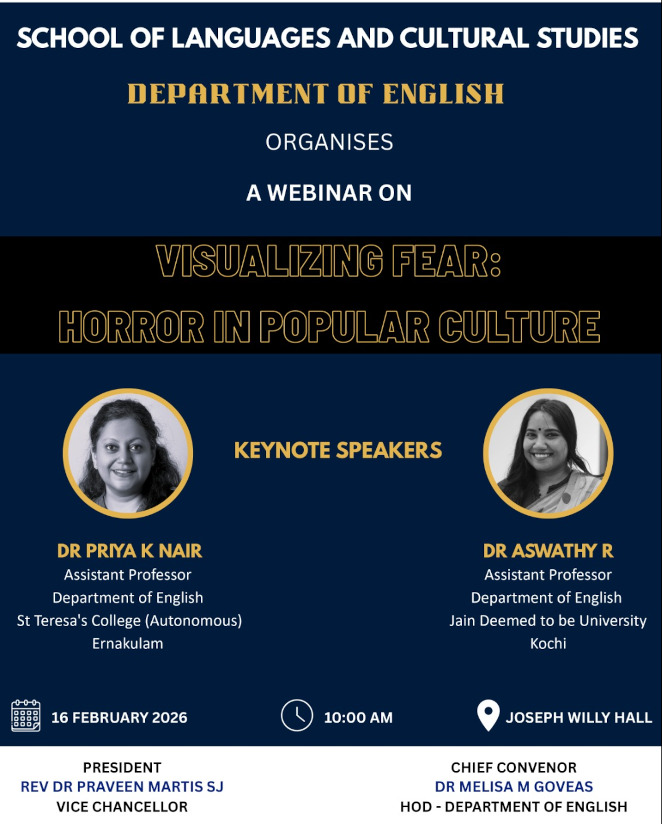
Event Snapshot
- 16 FEBRUARY 2026
- JOSEPH WILLY HALL
- Registration is currently open.
About This Event
Event Details
Note : Registration is open only to non-Aloysius University faculty members, students, and research scholars.
CONCEPT NOTE
In contemporary popular culture, horror has increasingly found expression through visual and
graphic forms that foreground the immediacy of fear, embodiment, and social anxiety. This webinar
examines how horror narratives—across cinema, OTT platforms, comics, graphic novels, and digital
visual media—deploy images, panels, screens, and fragmented storytelling to articulate cultural
tensions that often remain unspoken in realist discourse. By bringing together horror studies and
visual narrative theory, the webinar seeks to explore how fear is produced, circulated, and
experienced through visual storytelling.
Horror in popular culture operates not merely as entertainment but as a critical mode that exposes
the fractures of everyday life. Drawing on theoretical formulations of the uncanny (Sigmund Freud)
and abjection (Julia Kristeva), the webinar investigates how visual horror destabilizes the familiar,
rendering bodies, domestic spaces, and social relations strange and threatening. Monstrosity,
excess, and distortion in visual narratives often encode anxieties related to gender, embodiment,
class, caste, and marginality, transforming social fears into powerful visual metaphors.
Graphic narratives and visual storytelling intensify these effects through their unique formal
strategies. As theorized by Scott McCloud and Thierry Groensteen, comics and graphic texts rely on
fragmentation, closure, and spatial arrangement to shape readerly perception and affect. Horror,
when mediated through panels and images, disrupts linear time and stable meaning, compelling
readers to actively participate in the construction of fear. These visual forms foreground the body
as both spectacle and site of vulnerability, aligning with visual culture studies and affect theory (Sara Ahmed) that emphasize the circulation of emotions within cultural texts.
The webinar also considers the expanding visual ecology of horror in digital and popular media,
where cinematic language, graphic aesthetics, and online imagery intersect. Influenced by media
theory and cultural studies, discussions will explore how visual horror reflects broader social
conditions, including urban alienation, domestic instability, and cultural repression. In these
contexts, visual storytelling becomes a mode of social commentary, revealing how fear is shaped by
historical, ideological, and material realities.
By situating horror within the frameworks of visual narrative theory, cultural studies, and critical
theory, this webinar invites participants to reconsider the aesthetic, social, and political significance
of horror in contemporary popular culture. It foregrounds visual storytelling as a powerful medium
through which cultural anxieties are rendered visible and meaningfully contested.
SUB-THEMES
1.Horror as Visual Culture
Horror beyond genre: fear as a visual and cultural mode in popular narratives.
2.The Uncanny Image
Visualizing the uncanny in cinema, graphic narratives, and digital media.
3.Monstrous Bodies and Abjection
Gender, embodiment, and the aesthetics of monstrosity in visual horror.
4.Graphic Narratives and the Aesthetics of Fear
Comics, graphic novels, and visual fragmentation in horror storytelling.
5.Horror in Cinema and OTT Platforms
Visual spectacle, domestic spaces, and social anxiety in screen horror.
6.Affect, Emotion, and Visual Fear
Circulation of fear and affect in images, panels, and screens.
7.Digital Horror and Online Visual Storytelling
Memes, creepypasta, viral images, and participatory cultures of fear.
8.Popular Culture and the Politics of Representation
Visual horror as a site of ideology, power, and social critique.
CALL FOR PAPERS
We invite abstracts on the theme from academicians, research scholars, students, and working
professionals from related fields.
GUIDELINES FOR PAPER SUBMISSION
All submissions should follow the 9th edition of the MLA style.
Abstracts should be submitted in MS Word format, and the file should be named after the
author’s name.
Abstracts must not exceed 300 words.
The title page should include the full name of the author(s), designation, email ID, affiliation,
and title of the paper.
Soft copies of the abstracts may be sent as email attachments to
[email protected]
Last date for submission of abstracts: 13/02/2026
Download Brochure
Registration
Ready to take part?
Go through the event information, then continue with registration if this event matches your interest and schedule.
Confirm the event date and venue.
Open the registration form.
Submit your details and complete the process.